OpenAI and Microsoft Officially “Break Up”: The Most Important Alliance of the AI Era Finally Unbundles
On April 27, 2026, OpenAI and Microsoft released statements at the same time: the two companies had revised their partnership agreement.
You could call it a “breakup.” The reason is not hard to understand. Microsoft no longer has exclusive licensing rights to OpenAI’s models and products. OpenAI can offer products on any cloud platform. Microsoft will also stop paying revenue share to OpenAI. For the past few years, these two companies were almost treated as one AI camp. Now there is suddenly a line between them, and that is big news.
But in reality, it is not that absolute.
Microsoft remains OpenAI’s primary cloud partner. OpenAI products will still launch first on Azure. Microsoft remains a major shareholder and continues to hold IP licenses for OpenAI models and products until 2032. The difference is that the license is now non-exclusive. On the other side, OpenAI is not immediately stopping payments to Microsoft either. Related revenue sharing will continue until 2030, but with a total cap.
So I would not call it a complete breakup. A more accurate word is: unbundling.
The relationship has shifted from “Microsoft provides money and compute, OpenAI provides models and the future” to “we still cooperate, but neither side bets only on the other.” That better matches the size of both companies today. OpenAI is no longer a research institution that can only be carried by one cloud giant. Microsoft also cannot permanently tie its entire AI strategy to one external company.
To understand the April 27 agreement, we need to rewind the timeline.
2019: Why Microsoft Bet on OpenAI
On July 22, 2019, Microsoft announced a $1 billion investment in OpenAI. OpenAI announced on the same day that the two companies would jointly develop large-scale AI hardware and software platforms on Azure, and Microsoft would become OpenAI’s exclusive cloud provider.
Looking back today, that investment seems obvious. But in 2019, it was not.
There was no ChatGPT and no GPT-3 yet. OpenAI was already famous, but it looked more like a top research organization: strong talent, huge goals, and an unclear business model. What it needed was not ordinary servers, but infrastructure capable of training ever-larger models. Microsoft needed an ambitious AI partner to prove Azure could carry the next-generation AI platform.
Their needs matched.
OpenAI lacked money, compute, and enterprise infrastructure. Microsoft lacked a frontier model partner that could put Azure at the center of the AI era. From the beginning, this relationship was strongly tied to infrastructure.
Microsoft offered capital and cloud. OpenAI offered a ticket to the future.
2020: Azure Supercomputing and GPT-3 Made the Partnership Concrete
In May 2020, Microsoft announced that it had built an Azure AI supercomputer for OpenAI. According to Microsoft, the machine had more than 285,000 CPU cores, 10,000 GPUs, and 400Gbps networking for each GPU server.
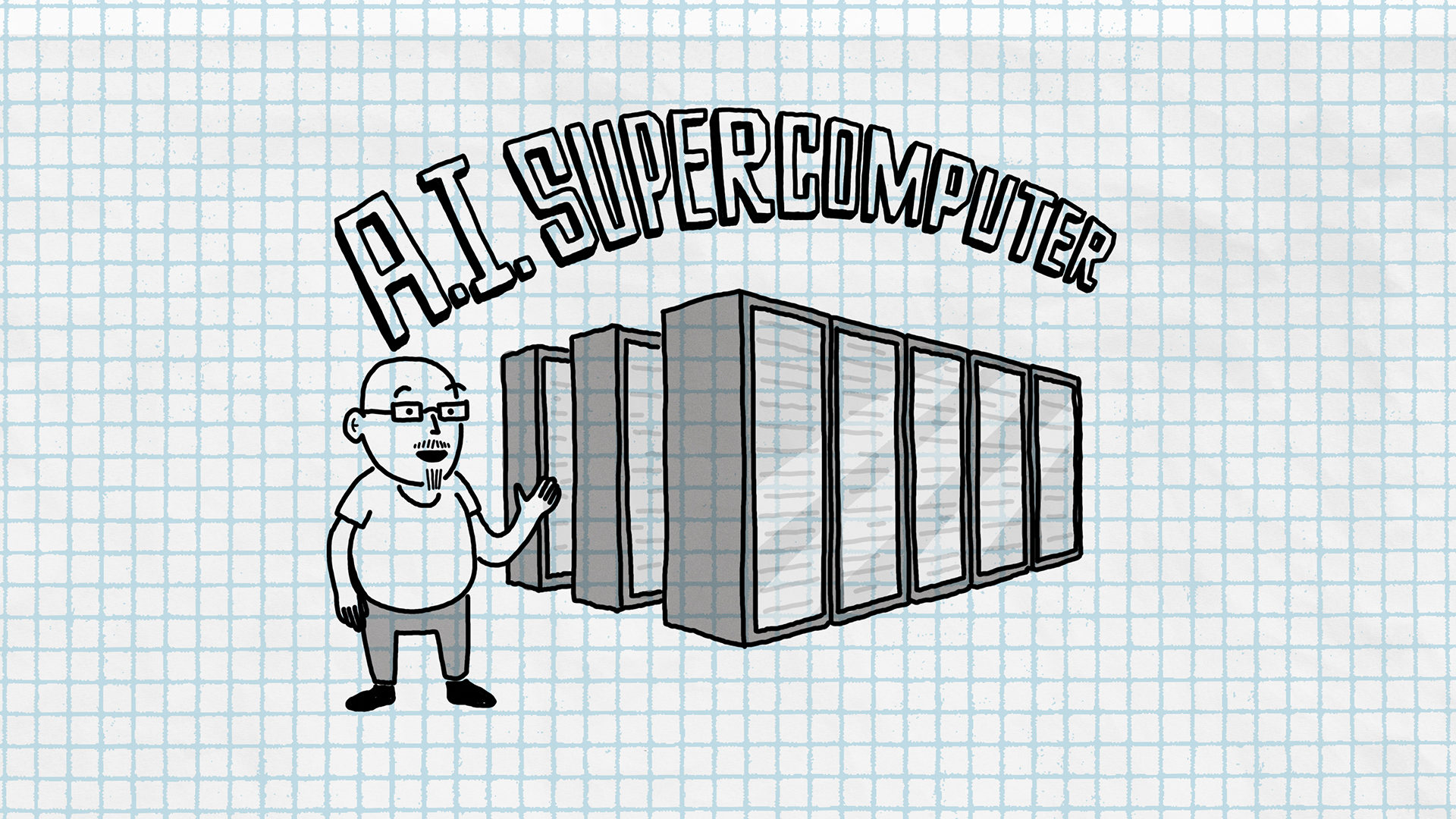
This was not a vague strategic partnership on a slide. It showed that OpenAI’s model training was already deeply dependent on Azure, while Microsoft was turning OpenAI’s needs into its own cloud capabilities.
A few months later, in September 2020, Microsoft announced an exclusive license for GPT-3. GPT-3 was one of the most watched language models at the time, with 175 billion parameters. After receiving the license, Microsoft could use GPT-3 in its own products and services. OpenAI also stated that developers could still use GPT-3 through the OpenAI API.
This step mattered. Microsoft was no longer only OpenAI’s cloud provider and investor. It had gained commercial rights to OpenAI’s core model. OpenAI, meanwhile, used Microsoft to enter enterprise software, developer ecosystems, and the cloud market.
Many later debates were already seeded here. OpenAI’s mission narrative was to make AGI benefit all of humanity, but its most important models, compute, and commercial channels were increasingly tied to a major technology company.
2021 to 2023: OpenAI Technology Enters Microsoft Products
After 2021, the partnership moved from infrastructure into concrete products.
GitHub Copilot was one of the first products that let ordinary developers feel this partnership. GitHub belongs to Microsoft. Copilot was developed by GitHub and OpenAI, using OpenAI Codex under the hood. It quickly moved beyond demos and into real development workflows, and later became a paid product.
By 2023, the pace accelerated.
On January 17, 2023, Azure OpenAI Service became generally available. Enterprise customers could use GPT-3.5, Codex, DALL·E 2, and other models through Azure while getting Azure’s security, compliance, and enterprise deployment capabilities.
A week later, Microsoft announced an expanded partnership with OpenAI, entering what it called the “third phase” with a multi-year, multi-billion-dollar investment. Microsoft said plainly that it would continue building AI supercomputing, deploy OpenAI models across consumer and enterprise products, and serve enterprise customers through Azure OpenAI Service.
That was basically the skeleton of Microsoft’s 2023 AI strategy.
OpenAI built frontier models. Azure carried the compute. Microsoft’s product lines distributed them. Bing, Edge, Office, Teams, Windows, GitHub, Dynamics, and Power Platform could all be remade as Copilot products.
In February 2023, Microsoft released the new Bing and Edge, bringing OpenAI models into search and the browser. Satya Nadella said at the time that AI would start with search and change every software category. Microsoft looked aggressive then, almost as if it were declaring war on Google.
In March, Microsoft 365 Copilot was released. Word, Excel, PowerPoint, Outlook, and Teams were repackaged as AI work entry points. At that point, OpenAI was no longer just an investment target. It had become a core component of Microsoft’s product story.
Microsoft clearly gained visibility during this phase.
ChatGPT ignited the market, OpenAI became the most watched AI company in the world, and Microsoft quickly transferred that attention to Azure and Copilot. To capital markets, Microsoft suddenly looked less like a mature software and cloud company and more like one of the key AI gateways.
The problem also became obvious then. The more successful OpenAI became, the more compute and customers it needed. Microsoft’s exclusive cloud, exclusive API, IP license, and revenue-sharing arrangements were initially support structures. Over time, they also became constraints.
November 2023: OpenAI’s Internal Crisis Made Microsoft Truly Nervous
In November 2023, OpenAI experienced the most chaotic governance crisis in its history.
Sam Altman was suddenly removed by the board. Over the following days, the story changed repeatedly: Microsoft said Altman, Greg Brockman, and OpenAI employees could join a new AI team at Microsoft; many OpenAI employees signed an open letter demanding the board resign and reinstate Altman; finally Altman returned and the board was reorganized.
This shocked Microsoft.
Microsoft had invested huge sums, integrated OpenAI models into its core products, and positioned Copilot as one of its most important growth stories for the next few years. Then a single internal decision by OpenAI’s board almost overturned the whole narrative. Microsoft had no voting rights and no real control. In the first few hours, it even looked passive.
After the crisis, Microsoft received a non-voting observer seat on OpenAI’s board. The seat could not vote, but it allowed Microsoft to attend board meetings and receive more information.
That was understandable. Microsoft did not necessarily need to control OpenAI, but it could not be kept in the dark at moments like that.
The observer seat also made outsiders more cautious: was Microsoft merely an investor and partner, or had it effectively begun influencing OpenAI’s governance? That question grew stronger later.
2024: Regulators Begin Scrutinizing the Microsoft-OpenAI Relationship
In January 2024, the U.S. FTC announced an inquiry into generative AI investments and partnerships, including Microsoft/OpenAI, Amazon/Anthropic, and Google/Anthropic.
Regulators were not focused on one particular investment. They were looking at the binding relationship between cloud giants and model companies.
Frontier AI companies need money, chips, data centers, and cloud services. Cloud giants need models to sell cloud, software, and enterprise solutions. This combination is natural, but also dangerous. If the binding becomes too deep, customers may only be able to access the strongest models through a specific cloud platform, and model companies may be locked into a specific cloud.
In July 2024, Microsoft gave up its OpenAI board observer seat. Microsoft said OpenAI’s new board had made significant progress and the seat was no longer necessary. Many observers linked the move to regulatory pressure.
Microsoft did not exit OpenAI, but it began making itself look less like a hidden controller. OpenAI also needed to prove it was not Microsoft’s attached lab.
2025: After Stargate, OpenAI Starts Moving Beyond Single-Cloud Dependence
The real loosening happened in 2025. Stargate was a large AI infrastructure project involving OpenAI, aiming to build new data centers and training compute in the United States.
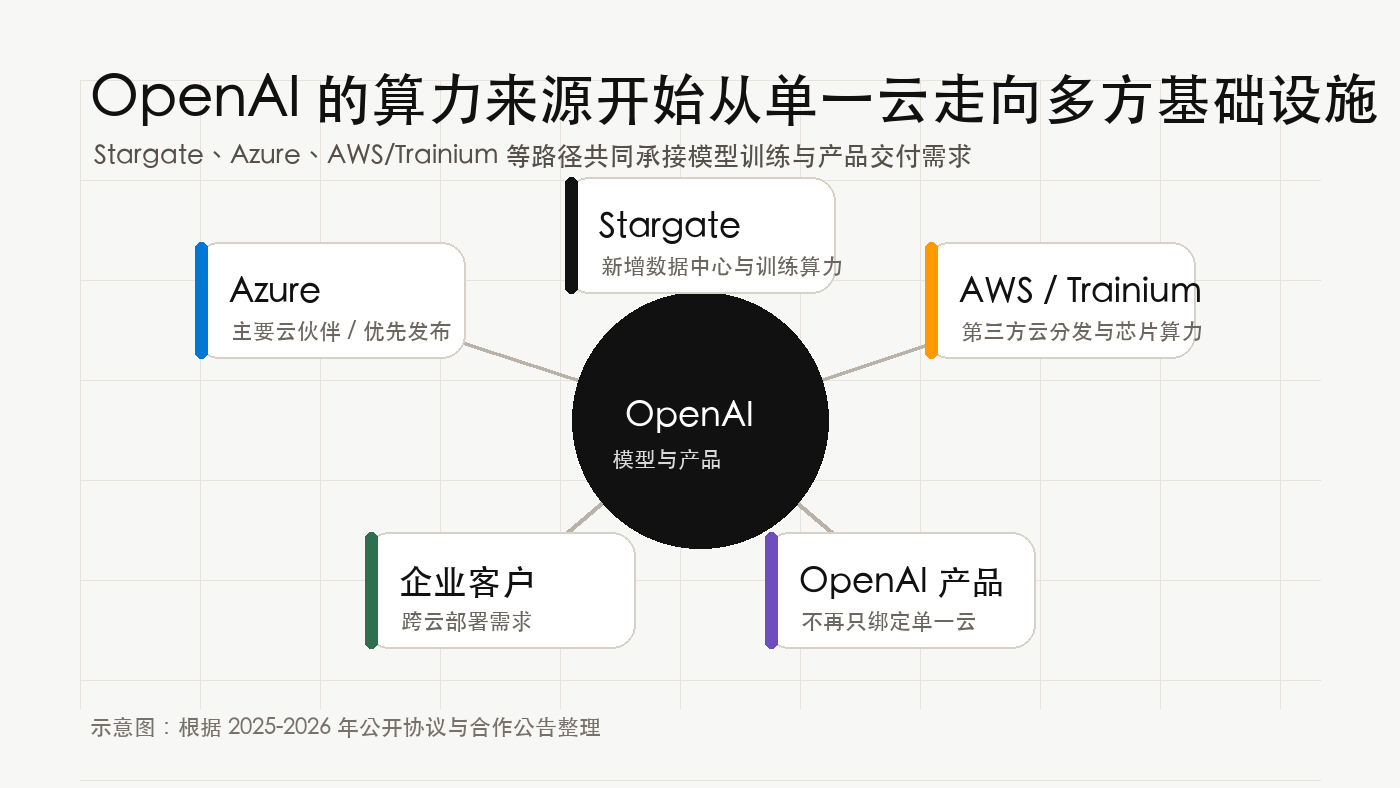
Diagram: compiled from public agreements and partnership announcements from 2025-2026.
In January 2025, OpenAI joined the Stargate infrastructure project. Microsoft then released a statement emphasizing that the main terms of the partnership remained: Microsoft continued to hold OpenAI IP rights, OpenAI API would remain exclusive to Azure, revenue sharing would continue, and Microsoft remained OpenAI’s main investor.
But the same statement also showed change: new compute would no longer be handled exclusively by Microsoft. Instead, Microsoft would have a right of first refusal. If Microsoft could not meet OpenAI’s additional compute needs, OpenAI could build extra capacity elsewhere, mainly for research and training.
That already explained the issue.
The bottleneck for large model companies is not in slide decks. It is in electricity, chips, and data centers. If OpenAI wanted to continue expanding, it could not rely on Azure forever. Microsoft is powerful, but not necessarily powerful enough to satisfy all of OpenAI’s compute appetite alone.
In October 2025, the two sides signed another definitive agreement. Microsoft supported OpenAI’s transition toward a Public Benefit Corporation and capital restructuring. After the restructuring, Microsoft held about 27% of OpenAI Group PBC, with an investment value of about $135 billion.
The agreement kept many bindings: OpenAI remained Microsoft’s frontier model partner, Microsoft continued to hold OpenAI IP rights, and Azure API exclusivity lasted until AGI.
But it also opened more doors. Microsoft’s model and product IP rights were extended to 2032 and included post-AGI models; research IP rights lasted until AGI was confirmed or 2030; OpenAI could co-develop certain products with third parties; Microsoft could pursue AGI independently or with third parties; OpenAI committed to purchasing an additional $250 billion of Azure services; and Microsoft no longer held a right of first refusal over OpenAI’s new compute suppliers.
This was not a sudden falling out. It looked more like early unbundling.
Microsoft needed to ensure that the capital, cloud resources, and product integrations it had invested in would not suddenly become invalid. OpenAI needed to ensure that future financing, public-market plans, cross-cloud sales, hardware partnerships, and infrastructure plans would not be locked by Microsoft. Both sides knew the old exclusive structure could not last forever.
February 2026: Amazon Enters, Microsoft Calms the Market
On February 27, 2026, OpenAI and Amazon announced a strategic partnership.
According to OpenAI and Amazon, the two companies would jointly develop a Stateful Runtime Environment based on OpenAI models and offer it to AWS customers through Amazon Bedrock; AWS would become the exclusive third-party cloud distribution provider for OpenAI Frontier; OpenAI would use 2GW of AWS Trainium compute; and Amazon would invest $50 billion in OpenAI.
This was not a small partnership.
AWS is one of Azure’s biggest competitors. OpenAI working with AWS means its enterprise products, model runtime environment, chip compute, and distribution channel all began entering Microsoft’s rival ecosystem.
On the same day, Microsoft and OpenAI released a joint statement emphasizing that their relationship had not changed.
The statement said Microsoft still maintained exclusive licensing rights for OpenAI models and product IP; revenue sharing remained unchanged; Azure was still the exclusive cloud for stateless OpenAI API; OpenAI first-party products, including Frontier, would still be hosted on Azure; and OpenAI could commit to other compute in Stargate-like projects because that was already permitted by the partnership framework.
Looking back, that statement felt like an attempt to cool the market.
It meant: Amazon entering does not mean Microsoft is out.
But two months later, the April 27 agreement made the point clearer: the old framework no longer fit OpenAI’s expansion speed.
April 27, 2026: The Exclusive Era Ends
On April 27, 2026, OpenAI and Microsoft announced a revised agreement.
Several changes matter most.
Microsoft remains OpenAI’s primary cloud partner, and OpenAI products will launch first on Azure unless Microsoft cannot or chooses not to support the required capability. But OpenAI can now provide all products through any cloud.
Microsoft continues to license OpenAI model and product IP until 2032, but the license is now non-exclusive.
Microsoft will no longer pay revenue share to OpenAI.
OpenAI will continue paying revenue share to Microsoft until 2030 at the same rate, but with a total cap, and the payments are no longer affected by OpenAI’s technical progress or AGI determination.
Microsoft remains a major shareholder participating in OpenAI’s growth.
That is where the “breakup” headline comes from. But if you put the terms together, it looks more like a reorganization of a complex relationship built over several years.
The old partnership contained several strong bindings: Azure exclusivity, Microsoft’s exclusive OpenAI IP rights, API exclusivity, two-way revenue sharing, and complex AGI-related terms. These are now simplified. Microsoft gives up exclusivity, OpenAI gains cross-cloud freedom; Microsoft stops sharing revenue with OpenAI, while OpenAI’s payments to Microsoft now have a timeline and cap; AGI no longer hangs over the commercial terms in the same way.
For OpenAI, this clears the road for independent expansion.
If it wants to serve the world’s largest enterprise customers, it cannot simply say, “you must come to Azure.” Many enterprises are already deeply tied to AWS, Google Cloud, or their own private cloud systems. If OpenAI wants to become a true platform, it needs to go where customers already are.
If it wants to keep financing, restructure, and perhaps eventually go public, it also needs a clearer business structure. An OpenAI locked by Microsoft’s exclusive cloud, exclusive IP, and uncertain AGI clauses would struggle to tell the market, “I am an independent platform company.”
For Microsoft, this is also a rebalancing.
Microsoft has already gained a lot: OpenAI equity, model licenses until 2032, Copilot product accumulation, Azure AI brand value, and enterprise customer mindshare. Forcing exclusivity to continue might bring rising regulatory risk and partnership friction.
Microsoft itself is also becoming multi-model. Over the past two years, it has developed internal models and introduced models from Anthropic and others into some Copilot scenarios. Microsoft still needs OpenAI, but it will not let its entire AI strategy depend only on OpenAI.
This Is a Platform and Infrastructure Partnership
The OpenAI-Microsoft partnership is often written in dramatic terms: Microsoft recognized the gem, OpenAI took off with Microsoft’s support, and the two companies challenged Google together.
That is not wrong, but it sounds too much like a business legend.
The more realistic version is that this was a platform power transaction.
OpenAI needed capital, compute, cloud, enterprise sales channels, and product distribution. Microsoft had all of them. Microsoft needed frontier models, an AI narrative, and new entry points for search and Office. OpenAI could provide them.
So it made sense that the two sides became more tightly bound from 2019 to 2023. Without Microsoft, OpenAI would have struggled to train and deploy models at the same speed. Without OpenAI, Microsoft would have struggled to gain such a strong position at the beginning of the generative AI wave.
From 2024 to 2026, the binding became expensive.
OpenAI needed more compute, more cloud partners, more enterprise customers, and capital markets to believe it was not Microsoft’s shadow company. Microsoft had its own pressures. OpenAI’s governance crisis reminded Microsoft that investing huge amounts of money did not mean it could truly control the company. Regulatory pressure reminded it that the more tightly it was tied to OpenAI, the easier it was to look like it was using cloud and capital to control the frontier AI market.
Unbundling is not surprising.
The two sides still need each other. They are simply both too large to depend only on each other.
Conclusion: The Partnership Is Not Over, but the Relationship Has Changed
The April 27, 2026 agreement should not be understood simply as “OpenAI and Microsoft broke up.”
It is more like a business relationship entering adulthood.
In the early stage, OpenAI needed Microsoft to help it get moving. Microsoft needed OpenAI to help it grab the first ticket to the AI era. At that time, exclusivity, revenue sharing, IP licensing, and cloud binding were acceptable tradeoffs.
Now OpenAI is an AI company with consumer entry points, an enterprise platform, a model ecosystem, and infrastructure ambitions. Microsoft is no longer merely OpenAI’s backer. It has embedded AI into Office, Windows, Azure, GitHub, and security products, and it is building its own multi-model strategy.
The two companies will continue to cooperate, and the scale will remain large.
But from now on, the relationship can no longer be summarized by “exclusive.” It is more like a realistic symbiosis: they need each other, but they no longer lock each other in.
That may be healthier for both sides. It also fits what is likely to happen next in the AI industry.
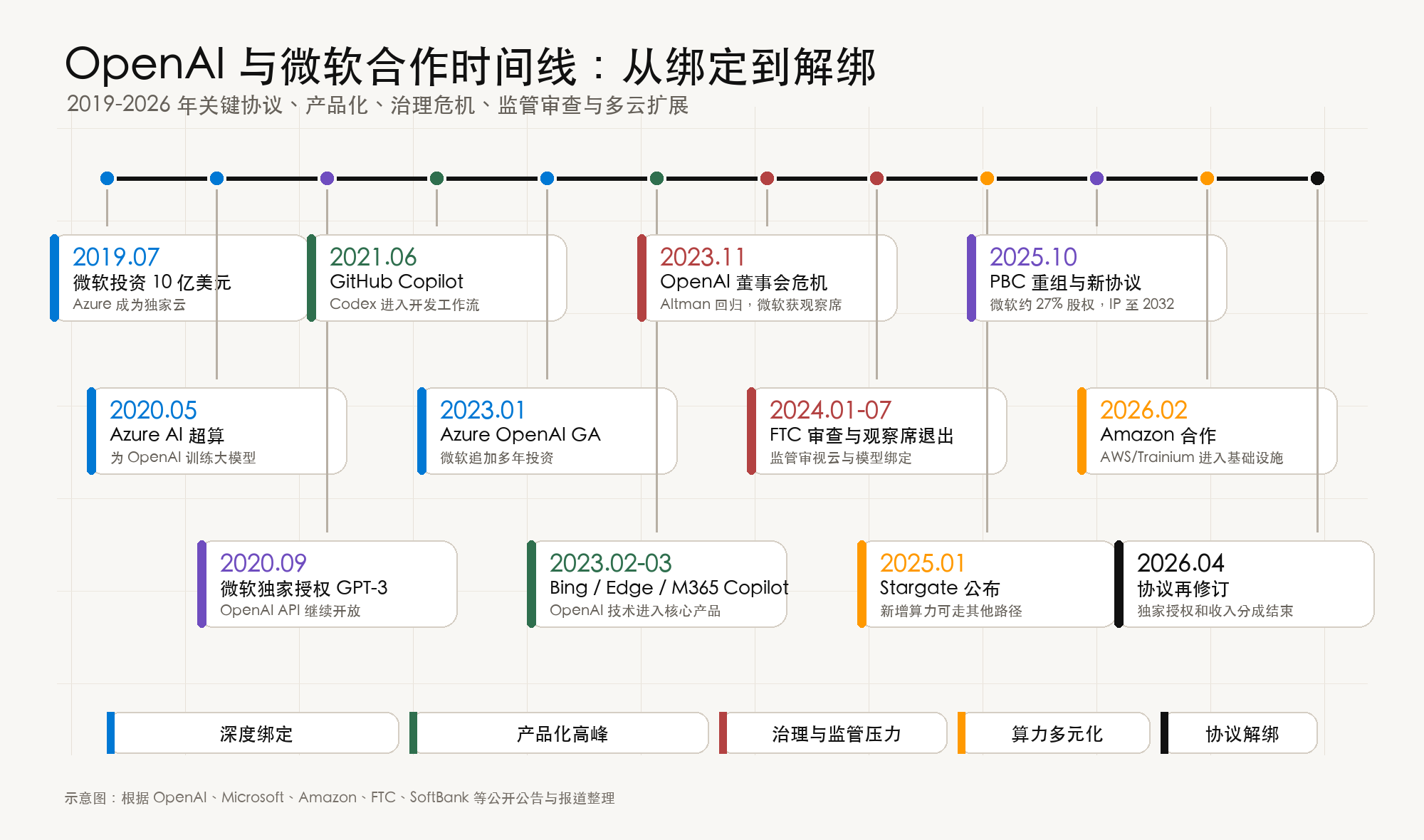
Timeline Overview
References
[1] OpenAI. The next phase of the Microsoft OpenAI partnership. 2026-04-27. https://openai.com/index/next-phase-of-microsoft-partnership/
[2] Microsoft. The next phase of the Microsoft-OpenAI partnership. 2026-04-27. https://blogs.microsoft.com/blog/2026/04/27/the-next-phase-of-the-microsoft-openai-partnership/
[3] Microsoft. The next chapter of the Microsoft-OpenAI partnership. 2025-10-28. https://blogs.microsoft.com/blog/2025/10/28/the-next-chapter-of-the-microsoft-openai-partnership/
[4] Microsoft. Microsoft and OpenAI evolve partnership to drive the next phase of AI. 2025-01-21. https://blogs.microsoft.com/blog/2025/01/21/microsoft-and-openai-evolve-partnership-to-drive-the-next-phase-of-ai/
[5] Microsoft. Microsoft and OpenAI joint statement on continuing partnership. 2026-02-27. https://blogs.microsoft.com/blog/2026/02/27/microsoft-and-openai-joint-statement-on-continuing-partnership/
[6] Microsoft Source. OpenAI forms exclusive computing partnership with Microsoft. 2019-07-22. https://news.microsoft.com/source/2019/07/22/openai-forms-exclusive-computing-partnership-with-microsoft-to-build-new-azure-ai-supercomputing-technologies/
[7] OpenAI. Microsoft invests in and partners with OpenAI. 2019-07-22. https://openai.com/index/microsoft-invests-in-and-partners-with-openai/
[8] Microsoft Source. Microsoft announces new supercomputer, lays out vision for future AI work. 2020-05-19. https://news.microsoft.com/source/features/ai/openai-azure-supercomputer/
[9] Microsoft. Microsoft teams up with OpenAI to exclusively license GPT-3 language model. 2020-09-22. https://blogs.microsoft.com/blog/2020/09/22/microsoft-teams-up-with-openai-to-exclusively-license-gpt-3-language-model/
[10] Microsoft Azure Blog. General availability of Azure OpenAI Service expands access to large, advanced AI models with added enterprise benefits. 2023-01-17. https://azure.microsoft.com/en-us/blog/general-availability-of-azure-openai-service-expands-access-to-large-advanced-ai-models-with-added-enterprise-benefits/
[11] Microsoft. Microsoft and OpenAI extend partnership. 2023-01-23. https://blogs.microsoft.com/blog/2023/01/23/microsoftandopenaiextendpartnership/
[12] GitHub. Introducing GitHub Copilot: your AI pair programmer. 2021-06-29. https://github.blog/news-insights/product-news/introducing-github-copilot-ai-pair-programmer/
[13] Microsoft. Reinventing search with a new AI-powered Microsoft Bing and Edge. 2023-02-07. https://blogs.microsoft.com/blog/2023/02/07/reinventing-search-with-a-new-ai-powered-microsoft-bing-and-edge-your-copilot-for-the-web/
[14] Microsoft. Introducing Microsoft 365 Copilot. 2023-03-16. https://blogs.microsoft.com/blog/2023/03/16/introducing-microsoft-365-copilot-your-copilot-for-work/
[15] Microsoft. A statement from Microsoft Chairman and CEO Satya Nadella. 2023-11-21. https://blogs.microsoft.com/blog/2023/11/21/a-statement-from-microsoft-chairman-and-ceo-satya-nadella/
[16] TechCrunch. Sam Altman’s officially back at OpenAI, and the board gains a Microsoft observer. 2023-11-29. https://techcrunch.com/2023/11/29/sam-altmans-officially-back-at-openai-and-the-board-gains-a-microsoft-observer/
[17] FTC. FTC Launches Inquiry into Generative AI Investments and Partnerships. 2024-01. https://www.ftc.gov/news-events/news/press-releases/2024/01/ftc-launches-inquiry-generative-ai-investments-partnerships
[18] CNBC. Microsoft drops its observer seat on OpenAI board amid regulatory scrutiny. 2024-07-10. https://www.cnbc.com/2024/07/10/microsoft-reportedly-drops-its-observer-seat-on-openai-board.html
[19] OpenAI. OpenAI and Amazon announce strategic partnership. 2026-02-27. https://openai.com/index/amazon-partnership/
[20] Amazon. OpenAI and Amazon Announce Strategic Partnership. 2026-02-27. https://press.aboutamazon.com/2026/2/openai-and-amazon-announce-strategic-partnership
[21] SoftBank/OpenAI. Announcing The Stargate Project. 2025-01-21. https://group.softbank/en/news/press/20250122
[22] Bloomberg. Microsoft to Stop Sharing Revenue With Main AI Partner OpenAI. 2026-04-27. https://www.bloomberg.com/news/articles/2026-04-27/microsoft-to-stop-sharing-revenue-with-main-ai-partner-openai
[23] AP. Microsoft cuts OpenAI revenue share in a fresh step to loosen their AI alliance. 2026-04-27. https://apnews.com/article/2a44fa94da6913074f97f916332b33f6
[24] TechCrunch. OpenAI ends Microsoft legal peril over its $50B Amazon deal. 2026-04-27. https://techcrunch.com/2026/04/27/openai-ends-microsoft-legal-peril-over-its-50b-amazon-deal/
[25] Hacker News. Microsoft and OpenAI end their exclusive and revenue-sharing deal. 2026-04-27. https://news.ycombinator.com/item?id=47921248