Jensen Huang's Exit: 33 Years of One Man and One Company

How did a graphics-card maker that once teetered on the edge of bankruptcy become one of the most important technology companies of the global AI era?
On November 12, 2026, NVIDIA released an announcement that shook the technology industry.
Company co-founder Jensen Huang resigned as president, chief executive officer, and a member of the board, effective immediately. NVIDIA chief financial officer Colette Kress will serve as interim CEO, and the board has begun a search for a permanent successor. Harvey C. Jones, who previously served as chief executive officer of Synopsys, was appointed chair of the board.
This means that Jensen Huang, who had led NVIDIA continuously for 33 years since founding the company in 1993, has ended his tenure as CEO.
For the technology industry, the significance of this event goes far beyond a change in one company’s leadership.
For more than three decades, Huang was almost synonymous with NVIDIA. He led the company through the PC gaming era, the GPU revolution, general-purpose computing, deep learning, and the cryptocurrency boom, and ultimately bet correctly on the explosion of generative AI.
As OpenAI, Google, Meta, and other tech giants poured enormous sums into building AI computing infrastructure, NVIDIA became one of the most important suppliers in this technological race.
What makes this even more remarkable is that NVIDIA began as a startup that simply wanted to make PC games look smoother. It once nearly went bankrupt after betting on the wrong technical path, and for a long time it was seen as just a graphics-card company.
So what exactly did Huang go through? And how did NVIDIA ride successive waves of technological change to build the business empire it has today?
The story begins with an ordinary child born in Taiwan.
I. 1963–1992: From Immigrant Teenager to Silicon Valley Engineer
In 1963, Jensen Huang was born in Taipei, Taiwan. During his childhood, his family moved to Thailand. Because of local unrest, his parents decided to send him and his older brother to the United States first. Huang was only nine years old at the time.
The brothers initially stayed with an uncle in Tacoma, Washington, and were later enrolled at Oneida Baptist Institute in Kentucky. Life at the school was far harder than they had imagined.
Huang has recalled in interviews that many of the children at the school were much older than he was, and that some students had complicated upbringings. He had to adapt to a new language, a new environment, and a new culture. He roomed with an older student and helped him learn to read; in return, the roommate taught him weight training.
Years later, this episode is often cited as an explanation for Huang’s toughness. Of course, it is hard to draw a simple causal line between a childhood experience and later business success. But at least from his personal history, facing unfamiliar environments and continually adjusting his life started very early.
Later, the family reunited in Oregon. Huang attended a local high school, graduated at 16, and then enrolled at Oregon State University to study electrical engineering. There he met his future wife, Lori.
After graduation, Huang worked at AMD and then at LSI Logic, gradually accumulating experience in semiconductor design, the chip business, and engineering management. In 1992, he also earned a master’s degree in electrical engineering from Stanford University.
This background later became an important foundation for his entrepreneurial career. Huang had both a semiconductor engineering background and a practical understanding of how chip companies turn technology into commercial products.
By 1993, he was 30 years old. The real adventure of his life was only just beginning.
II. 1993: NVIDIA Is Born in a Restaurant
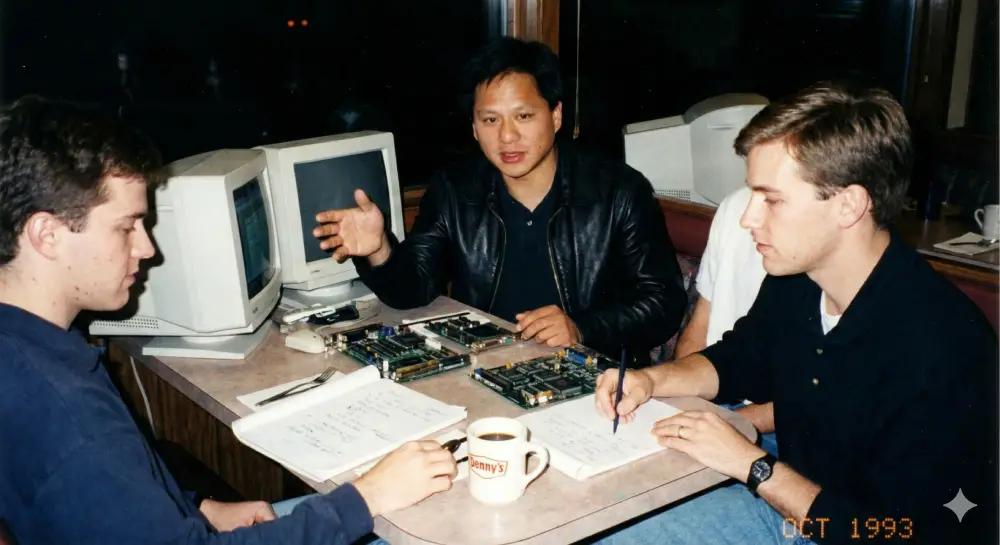
In 1993, the personal computer market was growing rapidly. Microsoft’s Windows operating system was spreading, Intel was driving CPU performance higher, and computers were gradually changing from office tools into home entertainment devices.
At the same time, 3D graphics technology was beginning to take off.
Huang spotted an opportunity: as computer games grew more and more complex, relying solely on the CPU for graphics computation would eventually hit a performance wall. Future computers might need chips dedicated to graphics processing.
With that idea, Huang and two other engineers, Chris Malachowsky and Curtis Priem, discussed starting a company at a Denny’s restaurant in San Jose, California.
The three of them decided to found a semiconductor company. That was the beginning of NVIDIA.
NVIDIA was officially founded on April 5, 1993.
It is worth noting that NVIDIA at the time had nothing like the clearly defined AI strategy it has today. Its main targets were the PC gaming and multimedia markets.
In that era, 3D accelerator chips were an intensely competitive field. The market was crowded with players such as 3dfx, ATI, S3, and Matrox, and graphics APIs and hardware standards had not yet fully converged.
No one could be sure which technical path would ultimately win. NVIDIA was just one of many startups.
And it soon made a nearly fatal mistake.
III. 1995–1997: The First Life-or-Death Crisis, Almost Failing Before the GPU Was Born
In 1995, NVIDIA launched its first product, the NV1. It was a chip that integrated graphics, audio, and multimedia functions. In terms of technical ambition, the NV1 was quite forward-looking.
It tried to combine multiple functions that had previously required separate hardware onto a single chip. The problem was that some of the 3D graphics techniques it used diverged from the polygon-rendering approach that later became mainstream.
As standards such as Microsoft’s Direct3D gradually developed, the technical direction NVIDIA had bet on faced growing pressure on compatibility and commercialization.
Worse still, NVIDIA had also collaborated with Sega on a graphics project. When the market and partners’ technical requirements changed, NVIDIA had to rethink its product direction.
For a cash-constrained startup, a failed chip project is extremely dangerous. Developing a chip consumes large amounts of engineering resources, and the cycle from design to tape-out to volume production is long. A wrong call can wipe out years of the company’s accumulated work.
That was the situation NVIDIA faced.
Huang ultimately decided to abandon parts of the original technical path and shift toward a graphics architecture more aligned with mainstream market standards.
In 1997, NVIDIA launched the RIVA 128. The product supported the mainstream 3D graphics standards of the time and achieved a breakthrough in performance and commercial success. The success of the RIVA 128 bought NVIDIA precious time and capital, and helped the company find its footing in a fiercely competitive market.
This episode later became an important turning point in NVIDIA’s history.
Choosing the wrong technical path is not what is truly dangerous. The real danger is refusing to abandon sunk costs after the market has already changed.
From then on, NVIDIA maintained an unusually sharp sensitivity to technological change. That trait would appear again in its later CUDA and AI strategies.
IV. 1999: The GPU Is Born, and NVIDIA Begins to Define an Industry
1999 was a milestone year for NVIDIA. That year, the company listed on Nasdaq. The same year, it launched the GeForce 256.
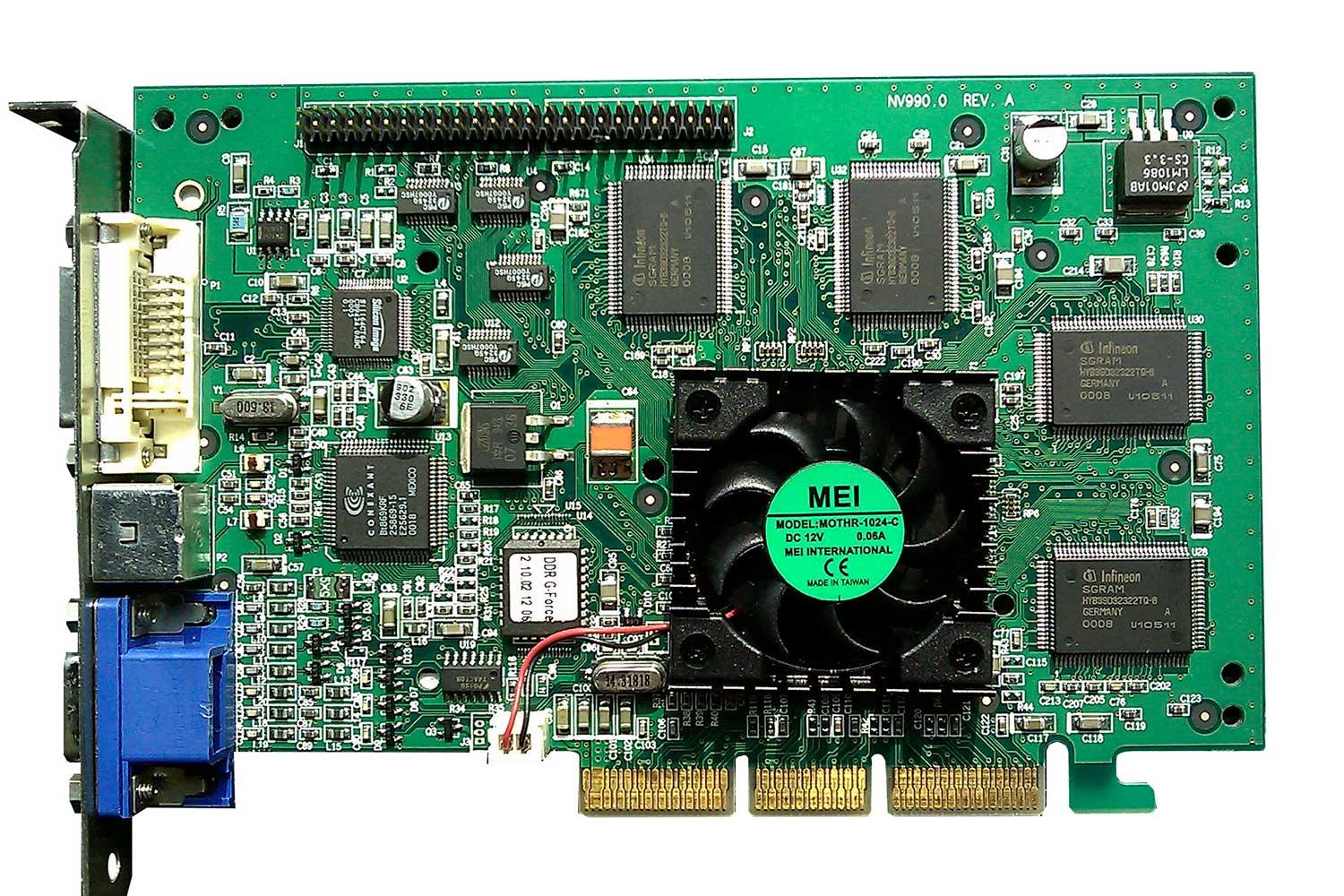
NVIDIA called the GeForce 256 the world’s first GPU, or Graphics Processing Unit.
Strictly speaking, dedicated graphics-acceleration hardware already existed before the GeForce 256. But through the GeForce 256, and through capabilities such as hardware transform and lighting integrated into it, NVIDIA further drove the adoption of the GPU as a product category.
Why do GPUs matter so much?
We can start by understanding the difference in how CPUs and GPUs compute. CPUs excel at complex logic, branching, and all kinds of general-purpose tasks. GPUs can use large numbers of parallel compute units to efficiently handle work that can be broken into many similar operations.
Rendering a 3D game frame, for example, requires performing similar mathematical operations on large numbers of vertices, textures, and pixels. These calculations are naturally well suited to parallel processing.
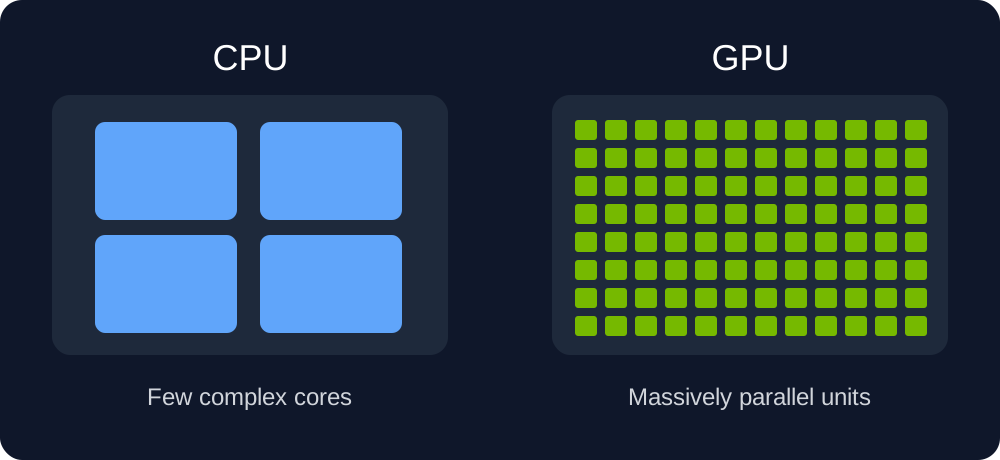
At the time, people paid attention to GPUs mainly because of games. Whoever’s graphics card could deliver higher frame rates and more realistic images had a chance to win over gamers and PC makers.
In the years that followed, NVIDIA gradually expanded its market share. In 2001, it entered the supply chain for Microsoft’s original Xbox, and the scale of its business grew rapidly.
From a startup on the brink of collapse to a public company with a mainstream graphics processor, NVIDIA took less than a decade.
But looking back from today, the decision that truly changed NVIDIA’s fate was still to come.
V. 2006: CUDA, a Long-Term Investment with No Immediate Payoff
If I had to pick one technology that determined NVIDIA’s position today, I would choose CUDA.
In 2006, NVIDIA introduced the CUDA architecture and subsequently provided developers with the corresponding software programming tools.
CUDA stands for Compute Unified Device Architecture. It made it easier for developers to use NVIDIA GPUs for general-purpose computing tasks.
This meant that the uses of the GPU began to break out of traditional graphics rendering. Scientific computing, physics simulation, financial modeling, and later the extremely important field of machine learning could all take advantage of the GPU’s parallel computing power.
But there was a huge commercial problem.
In 2006, there was simply no AI compute market on anything like today’s scale.
Deep learning had not yet seen its large-scale breakthrough, and generative AI was a very distant prospect. Most consumers still bought GPUs to play games.
Yet NVIDIA began building a software platform for developers that had no direct relationship to graphics-card gaming performance. This required long-term investment, including compilers, math libraries, drivers, development tools, technical documentation, and a developer ecosystem.
More importantly, these investments were hard to convert into graphics-card sales in the short term.
So why do it? Because NVIDIA saw another possibility for the GPU.
Graphics rendering itself is highly parallel mathematical computation, and fields such as scientific computing and neural networks likewise involve large numbers of mathematical tasks that can be executed in parallel. If the GPU could become a general-purpose parallel computing device, the market it faced would far exceed PC gaming.
This was, in effect, a bet on the future of computing architecture.
CUDA later helped NVIDIA build an extremely deep software-ecosystem moat. Developers write programs with CUDA, call libraries such as cuBLAS, cuDNN, and NCCL, and then combine them with frameworks such as TensorFlow and PyTorch to do their computing.
As software, toolchains, and engineering experience continued to accumulate, the cost for developers to migrate to other platforms also kept rising.
So when we discuss NVIDIA’s competitive advantages today, we cannot look only at GPU chip performance.
CUDA, and the vast developer ecosystem that formed around it, is one of NVIDIA’s hardest-to-replicate assets.
Of course, CUDA also has the limitations of a closed ecosystem. AMD’s ROCm, Google’s TPU, and various compilers and cross-platform computing frameworks are all trying to reduce the market’s dependence on CUDA. But that competition itself is, in a way, evidence of CUDA’s central place in modern accelerated computing.
VI. 2012: AlexNet Arrives, and NVIDIA Finally Sees AI Arrive
When CUDA launched in 2006, NVIDIA could not be sure which application would take off first. Its continued investment in general-purpose GPU computing also gradually made researchers realize that hardware originally designed for graphics rendering might be very well suited to training neural networks.
In 2012, the opportunity came.
That year, a deep neural network called AlexNet, developed by Alex Krizhevsky, Ilya Sutskever, and Geoffrey Hinton at the University of Toronto, achieved a breakthrough result in the ImageNet image-recognition competition.
The training hardware they used was two NVIDIA GTX 580 graphics cards.
The significance of AlexNet was enormous. Neural networks had already been studied for decades, but constrained by data, algorithms, and computing power, they had struggled to achieve large-scale breakthroughs.
AlexNet showed that combining large-scale datasets, deep neural networks, and GPU parallel computing could substantially improve accuracy on computer-vision tasks. Its ImageNet results led the entire academic community to reexamine the potential of deep learning. [Reference: the AlexNet paper][alexnet]
More importantly, researchers discovered that GPUs could dramatically improve the efficiency of neural-network training. This directly drove demand for GPUs in deep-learning research.
By then, CUDA had already been in development for six years. Developers could use existing GPU programming tools and the computing ecosystem to gradually run new deep-learning algorithms on NVIDIA hardware.
The investments NVIDIA had made over many years were finally beginning to pay off. Of course, AlexNet’s success also depended on researchers’ breakthroughs in algorithms, datasets, and training methods. But for NVIDIA, this was a crucial market validation.
From that year on, the role of the GPU gradually changed. It began to shift from a graphics-processing device for gamers into a core computing tool for AI researchers.
And Huang realized that NVIDIA would have to transform further.
VII. 2016–2020: From Selling Graphics Cards to Selling AI Supercomputers
In 2016, NVIDIA launched the DGX-1, a computing system built specifically for deep-learning workloads. It integrated eight Tesla P100 GPUs, along with the corresponding software and system architecture.
That year, Huang personally delivered a DGX-1 to OpenAI, and Elon Musk was there to receive it.

That scene looks highly symbolic in retrospect. At the time, OpenAI was far from the influence it has today, and ChatGPT would not appear for another six years.
But NVIDIA was already starting to sell its products to AI research institutions.
This represented an important change in the company’s business model. In the past, NVIDIA mainly sold GPU chips and related products. Now, it began offering customers a computing platform that integrated GPUs, interconnects, system software, and development tools.
In 2017, NVIDIA launched the Tesla V100, based on the Volta architecture. This generation introduced Tensor Cores, designed specifically to accelerate the matrix operations used heavily in deep learning.
This meant NVIDIA had begun designing at the hardware-architecture level specifically for AI computing.
At the same time, as deep-learning models continued to grow in scale, a new problem emerged.
No matter how powerful a single GPU was, it could not complete every computing task on its own. If hundreds, thousands, or even tens of thousands of GPUs were needed to train a model together, the communication capability between GPUs would become extremely important.
Computing was no longer just about the chip itself. It was becoming a systems-engineering problem.
In 2020, NVIDIA Spent $7 Billion to Buy Mellanox
In 2020, NVIDIA completed its acquisition of Mellanox, an Israeli high-speed networking company, in a deal valued at about $7 billion.
This transaction later became another extremely important node in NVIDIA’s history.
Why would a GPU company need to acquire a networking-technology company? Because in large-scale AI training, compute performance is often constrained by communication efficiency.
Suppose a training job requires 1,000 GPUs to participate at once. If the GPUs cannot exchange data efficiently, even the most powerful compute performance can be wasted waiting on communication.
Mellanox’s InfiniBand, high-speed Ethernet, and related technologies could help NVIDIA build more efficient large-scale computing systems. Combined with NVIDIA’s own interconnect technologies such as NVLink and NVSwitch, NVIDIA gradually built complete communication capabilities both within nodes and between them.
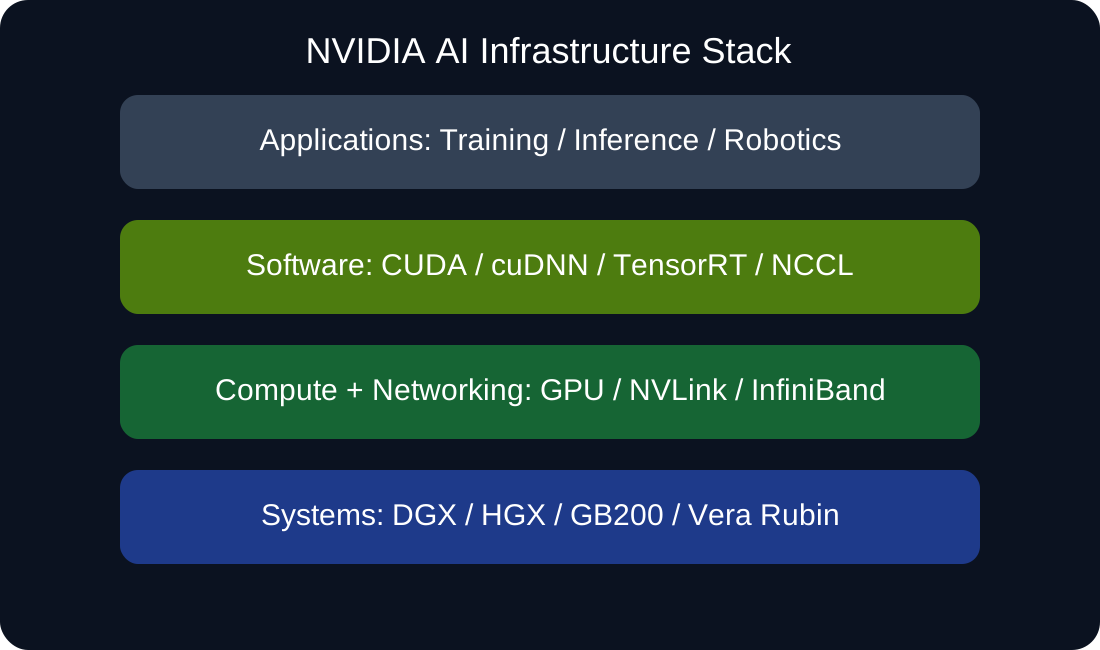
NVIDIA began integrating compute, networking, and software into a complete infrastructure stack.
In the past, customers might only have needed to buy GPUs. Now, customers had to consider the throughput, communication efficiency, power consumption, reliability, and operating costs of an entire AI cluster. And NVIDIA wanted to provide the complete solution.
This also became an important foundation for the high profit margins it later maintained.
VIII. 2022–2025: ChatGPT Ignites the AI Revolution, and NVIDIA Takes Off
In November 2022, OpenAI released ChatGPT. Generative AI began rapidly reaching the general public.
But for NVIDIA, this revolution did not start from zero. Long before ChatGPT’s release, NVIDIA had already accumulated a large body of AI-oriented technology and products.
The Hopper-architecture H100 GPU, launched in 2022, subsequently became important hardware for training and inference of large language models.
Why do large language models depend so heavily on GPUs? The reason is similar to that of AlexNet in its day, but the scale is entirely different.
Large language models, typified by the Transformer, need to perform enormous numbers of matrix multiplications and tensor operations. The GPU’s highly parallel compute capability and high-bandwidth memory have clear advantages in these workloads.
At the same time, as model parameter counts, training data, and context lengths continued to grow, the computing resources AI companies needed also increased rapidly.
Whether OpenAI, Google, Meta, or various cloud-computing companies, all began building large-scale GPU clusters. The H100, the H200, and subsequent products based on the Blackwell architecture became important components of this wave of AI infrastructure investment.
In 2024, NVIDIA launched the Blackwell architecture. Subsequently, rack-scale systems such as the GB200 NVL72 deeply integrated GPUs, CPUs, high-speed interconnects, and liquid-cooling infrastructure.
In 2026, NVIDIA pushed further with the Vera Rubin platform, aimed at even larger-scale AI training, inference, and agent workloads.
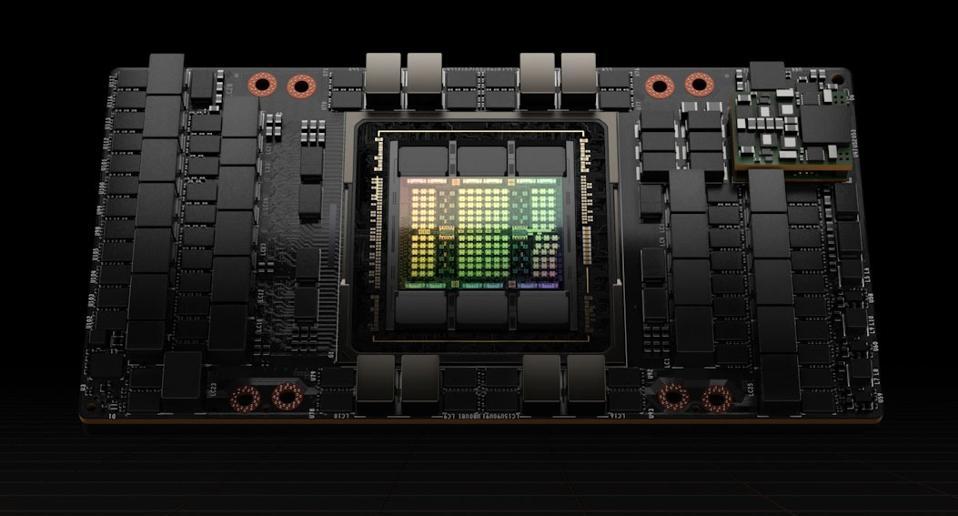
NVIDIA is gradually extending the boundaries of its products, from individual accelerator cards to complete AI data centers.
How Much Money Has NVIDIA Actually Made?
Look at its financial results, and you can see just how dramatic this change has been.
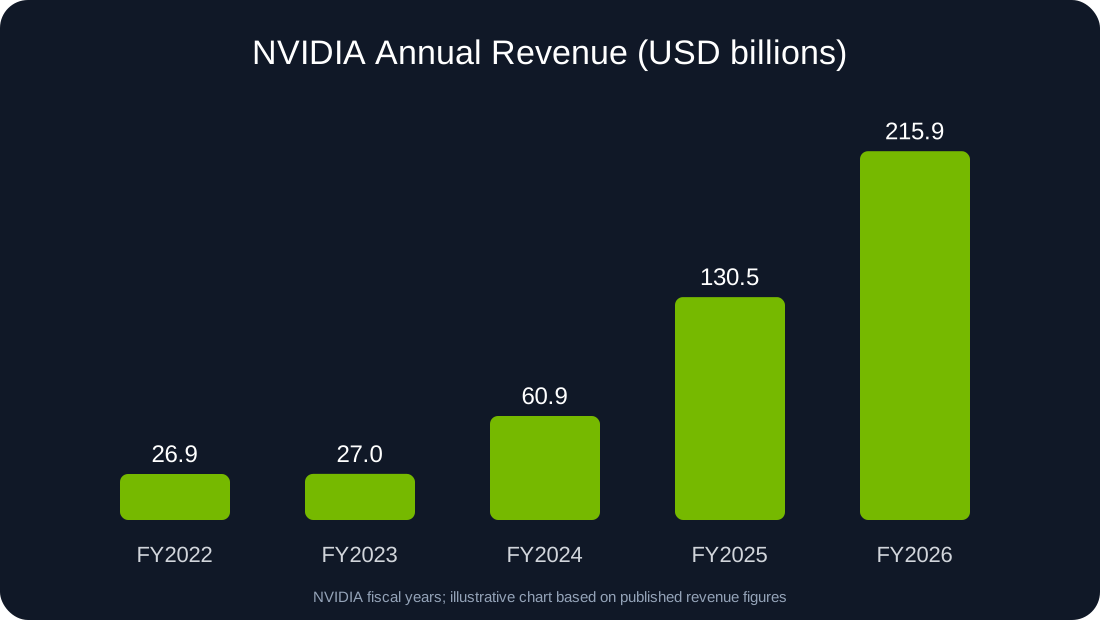
In fiscal 2026, NVIDIA’s revenue reached $215.9 billion, up about 65% year over year; net income was about $120.1 billion; Data Center revenue was about $193.7 billion; and full-year GAAP gross margin was about 71.1%. [Source: NVIDIA financial results][fy2026]
Even more noteworthy is that NVIDIA’s Data Center business revenue has already far surpassed its traditional gaming business.
According to the fiscal 2026 results, the Data Center business contributed about 90% of full-year revenue. NVIDIA, once known for its gaming graphics cards, has completely changed its primary source of income.
On October 29, 2025, NVIDIA became the first publicly listed company whose market capitalization briefly surpassed $5 trillion. Market cap fluctuates with the stock price; this milestone reflected the capital market’s high expectations at the time for AI infrastructure.
Thirty-three years earlier, Huang and two engineers had sat in a restaurant discussing how to do computer graphics well. Thirty-three years later, NVIDIA had become a core supplier of the world’s AI computing infrastructure.
IX. What Did NVIDIA Get Right?
Looking back at NVIDIA’s trajectory, I think what is most worth studying is how it continually expanded the computing market it served, while gradually building a complete technology ecosystem.
There are three key factors.
1. Entering the market through the GPU, and building an ecosystem through CUDA
If NVIDIA had only focused on the graphics performance of its cards, it would likely still be an important consumer-electronics chip company today. CUDA changed that.
It turned the GPU into a more general-purpose computing device, and through a software ecosystem it connected developers, algorithm frameworks, and the hardware platform. When AI demand exploded, NVIDIA already had a relatively mature computing platform.
This was more than a decade of technical accumulation.
Even if a competitor launches a high-performing GPU, it still has to solve problems of programming tools, compute libraries, framework support, and developer migration.
For large AI companies, the cost of buying hardware is only part of the picture. Development efficiency, model compatibility, cluster stability, and the cost of migrating existing code also influence technology choices. That is the advantage of an ecosystem.
2. Upgrading from a component supplier to a full-system supplier
Early NVIDIA mainly provided graphics chips. Later, it gradually expanded into compute modules, servers, high-speed networking, system software, and data-center-scale computing platforms.
Why does this change matter? Because in large-scale AI clusters, overall performance often depends on how efficiently multiple components work together.
For example, a 20% increase in the performance of a single GPU does not necessarily mean a 20% speedup for an entire model-training job. Network communication, data loading, memory capacity, compute scheduling, and other factors can all become bottlenecks.
Through vertical integration, NVIDIA can optimize performance and efficiency at the level of the entire system. This capability has gradually given it stronger bargaining power when selling products.
3. A willingness to invest early in technology markets that were not yet mature
NVIDIA’s most important transformations in its history share a common trait: when they happened, the target market was often not yet fully mature.
In 1993, 3D graphics acceleration was still in its early stages. In 2006, general-purpose GPU computing still lacked a clear, large-scale commercial payoff. In 2016, deep learning was already attracting attention, but it had not yet become a priority for infrastructure investment by global tech giants. In 2020, NVIDIA made a further bet on data-center-scale interconnects and system architecture.
Only when generative AI exploded in 2022 did many of those earlier technical investments concentrate into commercial value.
Of course, this strategy came with enormous risk. NVIDIA itself did not bet correctly every time. The failure of the NV1 is the most typical example. In addition, around 2018 and 2022, the GPU market was also hit by shifts in cryptocurrency demand, inventory cycles, and fluctuations in the consumer market.
So it is incomplete to attribute NVIDIA’s success simply to Huang’s having a visionary eye. It also depended on technical R&D, capital investment, engineering teams, supply-chain partnerships, changes in industry standards, and the long-term innovation of AI researchers.
NVIDIA’s success is the result of long-term technical accumulation and a sudden surge in market demand working together.
X. 2026: Huang Leaves, and NVIDIA Faces Its Most Unusual Challenge Yet
On November 12, 2026, Jensen Huang formally stepped down as CEO of NVIDIA.
The event had been preceded by personal controversy and related allegations, and the board had issued a statement from independent directors. Allegations not confirmed by authoritative investigation should be distinguished from the confirmed facts of the management change. This article does not make conclusive claims about allegations that have not been substantiated. [NVIDIA board announcement][board]
That said, more than the personal controversy itself, I am more concerned with another question:
Has a company led continuously by the same founder for 33 years built organizational capabilities mature enough to keep developing after the founder leaves?
Huang’s role at NVIDIA was highly unusual. He was the founder, the long-term setter of technical strategy, and someone deeply involved in product launches, ecosystem building, customer partnerships, and major business decisions.
For many years, NVIDIA’s technical direction was closely tied to Huang’s personal judgment.
Today, NVIDIA already has a complete R&D system, a large engineering organization, a mature product roadmap, and a vast base of customers and developers around the world. These are the company’s long-term assets.
But a founder’s departure still brings new uncertainty. Especially against a backdrop of intensifying competition in the AI industry, the problems NVIDIA faces may be more complex than in the past.
On one hand, AMD, Google’s TPU, and other custom AI accelerator chips continue to advance. On the other, as model architectures, inference-optimization techniques, and compute demand keep changing, the market’s degree of dependence on GPUs may also change.
In addition, U.S. export restrictions on advanced chips, the global supply-chain landscape, and the financial risks created by large cloud companies’ continued investment in AI infrastructure will all affect NVIDIA’s future.
After Huang’s departure, NVIDIA will for the first time truly face this test: when the founder’s personal influence leaves the company’s highest management post, can the technical system and organizational mechanisms accumulated over 33 years continue to sustain a competitive advantage?
The answer will take time to verify.
Closing Thoughts
What draws me most to Huang’s entrepreneurial story is those technical choices whose time horizons stretched across a decade.
In 1993, when he and two other engineers decided to start a company, the GPU market was still in its infancy.
In 1997, NVIDIA nearly collapsed under its first generation of products because it had chosen the wrong technical path.
In 1999, the GeForce 256 helped NVIDIA establish an important position in the GPU field.
In 2006, CUDA set NVIDIA on the path toward general-purpose computing.
In 2012, AlexNet demonstrated the importance of GPUs for deep learning.
In 2020, the Mellanox acquisition took NVIDIA further toward data-center-scale computing systems.
After 2022, the wave of generative AI set off by ChatGPT concentrated the release of all that accumulated work.
Looking back at the whole process, you will find that NVIDIA did not, from day one, draw up a complete plan for building an AI empire. It continually adjusted the boundaries of its products in response to technological development, while keeping investment in certain long-term directions.
There was judgment in this, and luck, and several near-failures.
In 2026, Huang’s departure put an unexpected period at the end of this 33-year entrepreneurial journey.
Whatever one makes of the personal controversy surrounding him, his historical role in the development of GPUs, accelerated computing, and AI infrastructure has already left a deep mark.
But NVIDIA’s story is clearly not over.
From the personal computer to the internet, from mobile computing to artificial intelligence, the center of the computing industry has shifted many times. Today’s GPUs and AI data centers sit at the center of a technological wave; in the future, new computing architectures, new hardware platforms, and new industrial landscapes may also emerge.
In 33 years, Jensen Huang took a graphics-card startup to the center of the global AI industry.
Next, NVIDIA needs to prove that even without Huang, it can still lead the next technological shift.
References and Image Notes
- NVIDIA Announces CEO Transition — NVIDIA, official announcement of the 2026 CEO transition.
- NVIDIA Corporate Timeline — NVIDIA’s official corporate history and key milestones.
- NVIDIA in Brief — A company overview and development summary.
- NVIDIA Investor Presentation — Historical business, technology strategy, and financial materials.
- CUDA Toolkit Documentation — Official NVIDIA CUDA technical documentation.
- ImageNet Classification with Deep Convolutional Neural Networks — The original AlexNet paper, 2012.
- NVIDIA Completes Acquisition of Mellanox — NVIDIA, announcement of the 2020 Mellanox acquisition.
- NVIDIA DGX Systems — Official introduction to NVIDIA DGX AI computing systems.
- NVIDIA H100 Tensor Core GPU — An overview of the H100 architecture and technology.
- NVIDIA Blackwell Architecture — An introduction to the NVIDIA Blackwell GPU architecture.
- NVIDIA Investor Relations — Annual and quarterly financial results and investor materials.
- NVIDIA Annual Reports — NVIDIA annual financial reports.
- NVIDIA Newsroom — Official NVIDIA news and product announcements.