What Math Is Hidden Behind Gojo Satoru's Infinity?
I read an interesting short math paper today. It came from a recent Oxford mathematics competition, titled Mathematics Behind Jujutsu Kaisen: Gojo Satoru’s Infinity. It does something fun: it treats Gojo Satoru’s Limitless technique in Jujutsu Kaisen as a mathematical object.
This kind of article can easily turn into a joke. This one does not. It does not stop at “anime settings are fun.” It keeps pushing Gojo’s technique into actual mathematical language. The real question it asks is:
If the Limitless technique is not just a dramatic line, but a mechanism of space, how would mathematics look at it? In this article, I will refer to the technique as “Infinity.”
Starting With Zeno: Infinite Steps Do Not Mean Impossible Arrival
The way Gojo explains Infinity is very close to an old philosophical paradox: Zeno’s paradox.
Zeno says that for Achilles to catch a tortoise, he must first reach the tortoise’s original position. But during that time, the tortoise moves a little farther. Achilles then has to reach the tortoise’s new old position, while the tortoise moves again. This process can be divided endlessly, so Achilles seems unable to ever catch the tortoise.
Gojo’s Infinity appears to have the same structure. There is always some distance between the attacker and Gojo, and that distance can keep being halved. The attack first crosses half the remaining distance, then half of what remains, then half again. Before it actually touches Gojo, it seems to face infinitely many steps.
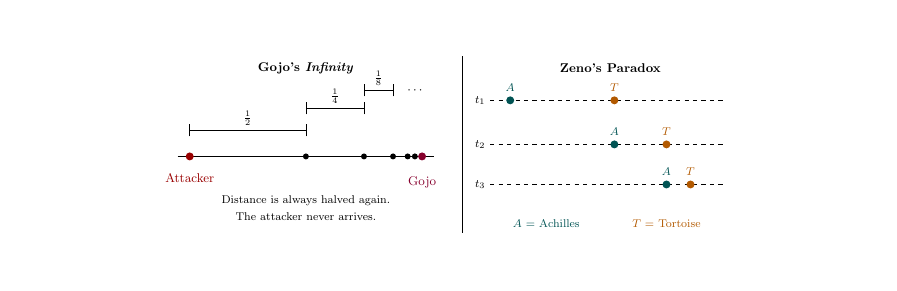
The key point is: infinitely many steps do not necessarily mean something can never be completed.
That is because the lengths of these steps are not fixed. They keep getting smaller. The classic example is:
$$ \frac12+\frac14+\frac18+\frac1{16}+\cdots=1 $$
This is a geometric series. In simple terms, if each term shrinks by a fixed ratio, and that ratio is less than 1, infinitely many terms can still converge to a finite value.
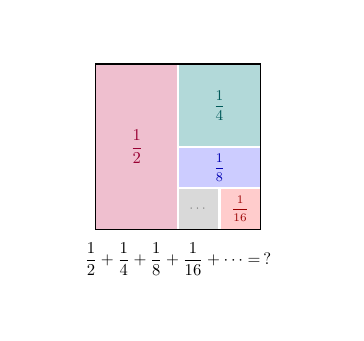
So from the perspective of geometric series, Gojo’s Infinity is actually fragile. The attacker may need to pass through infinitely many subdivided intervals, but the total length of those intervals can still be finite. As long as speed and time allow it, there is no mathematical barrier that says the attacker can never arrive.
This is the first interesting judgment in the paper: if Infinity only means infinite subdivision of distance, it does not make a real defense.
Lebesgue Measure: Infinitely Many Points Can Still Have No Length
The paper then introduces a more technical concept: Lebesgue measure.
The term sounds intimidating, but the question behind it is simple: how much length does a set occupy on the real line?
For example, the interval $[0,1]$ has length 1, and the interval $[2,5]$ has length 3. That matches intuition. But what if a set is not a continuous interval, just a bunch of points? For example:
$$ Z=\left{\frac12,\frac34,\frac78,\ldots\right} $$
This set has infinitely many points, and they get closer and closer to 1. Intuitively, it feels dense near 1, but Lebesgue measure tells us that its length is still 0.
Why? Because every point can be covered by an extremely small open interval. Cover the first point with an interval of length $\varepsilon/2$, the second with one of length $\varepsilon/4$, the third with one of length $\varepsilon/8$. The total length of all covering intervals is:
$$ \frac{\varepsilon}{2}+\frac{\varepsilon}{4}+\frac{\varepsilon}{8}+\cdots=\varepsilon $$
And $\varepsilon$ can be made arbitrarily small, so the measure of this set is 0.
This matters for understanding Infinity. If Gojo’s barrier is made only from these subdivision points, then even though it contains infinitely many points, it occupies no length in ordinary Euclidean space. In measure-theory language, it is a measure-zero set.
That pushes the question deeper:
If the points themselves have no length, why does the attack still stop?
The Real Defense Is Not in the Points, but in the Ruler
The second half of the paper turns to Riemannian geometry. This explanation starts to feel much closer to a real “technique.”
When we usually talk about the distance between two points, we default to Euclidean distance. For example, in a two-dimensional plane:
$$ ds^2=dx^2+dy^2 $$
But in Riemannian geometry, space can be curved, and the way distance is calculated can change with position. More generally, distance is written as:
$$ ds^2=\sum_{ij}g_{ij}dx_i dx_j $$
Here, $g_{ij}$ is called the metric tensor. You can think of it as the rule for the ruler inside space. The same step $dx$ may correspond to a different actual distance $ds$ at different positions.
This is the paper’s key explanation of Gojo’s Infinity: it does not merely split distance into infinitely many pieces. It changes the metric of space itself.
Far from Gojo, the ruler of space is normal. Moving 0.1 meters is just 0.1 meters. The closer you get to Gojo, the larger the metric factor becomes. The same physical displacement of 0.1 meters might be experienced by the attacker as 1 meter, 10 meters, 100 meters, or even something tending toward infinity.
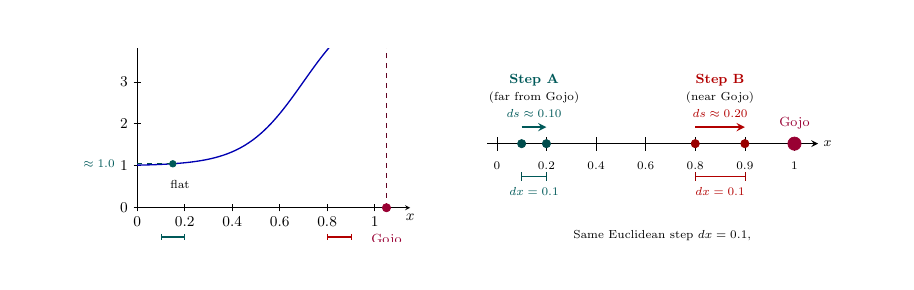
This is much stronger than “infinite halving.”
Geometric series only tells us that infinite subdivision may fail to stop an attack. Lebesgue measure only tells us that infinitely many points may occupy no length. But if the metric of space itself has changed, the question is no longer whether ordinary distance can be crossed. The spatial rules experienced by the attacker have already been rewritten.
In one sentence:
Gojo’s real strength is not that he creates many points. It is that he swaps in a ruler with different markings.
Why Can Sukuna’s Cleave Bypass Infinity?
The paper finally moves the problem into topology.
Topology does not care about fine quantities like length or angle. It cares about more basic structure, such as continuity, connectedness, and whether a boundary has been cut. In Gojo’s Infinity, the key object is the function $\Omega(x)$ that describes how much space is stretched.
As long as $\Omega(x)$ is continuous, the attacker must approach Gojo step by step through space. The closer the attacker gets, the larger the metric becomes, and the more the experienced distance is stretched. No matter how fast an ordinary attack is, it must obey the rules of this continuous space.
But what Mahoraga and Sukuna do is not “pass through Infinity.” They cut open the space that carries Infinity.
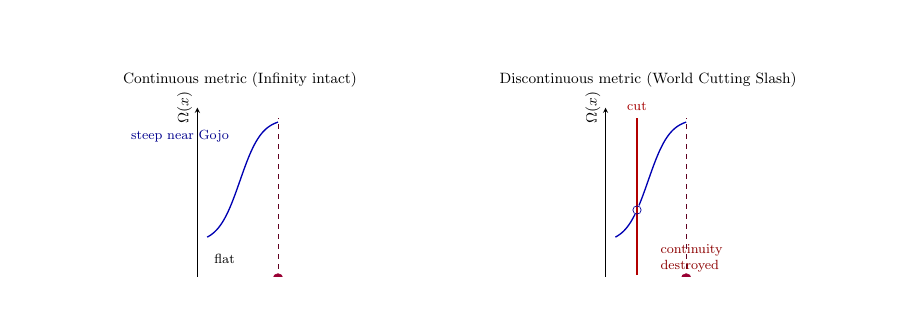
This is the mathematical meaning of world-cutting Cleave. It no longer targets Gojo himself, and it no longer tries to cross those subdivided points. It attacks the continuity of space directly. Once space is cut, the metric function originally defined on that space loses its meaning across the cut.
So Sukuna does not break through Gojo’s Infinity with greater force. He changes the problem itself.
This is the best part of the paper. A seemingly combat-oriented setting is translated into a mathematical question:
If a defense mechanism depends on space being continuous, can it still work when an attack directly cuts that continuity?
The answer is clearly no. Gojo’s Infinity was not “passed through.” The spatial rule that allowed it to exist was cut open. You could say Sukuna did not solve a defense problem. He cut the paper the problem was written on.
What Makes This Paper Interesting
What I find most worth sharing is not only that the paper connects anime with mathematics. It also shows a good path for explanation.
The same “Infinity” looks completely different under different mathematical languages:
| Mathematical Language | What It Sees in “Infinity” |
|---|---|
| Geometric series | Infinitely many steps can have a finite total, so infinite subdivision does not automatically make a barrier |
| Lebesgue measure | Countably infinite points can have length 0, so the point set itself occupies no space |
| Riemannian geometry | After the metric changes, the same physical displacement creates a different distance experience |
| Topology | If spatial continuity is cut, a defense that depends on continuity also fails |
This is a good case for math education. It shows that mathematics is not only calculation, and it is not only abstract symbols. Mathematics is more like a set of languages for looking at the world. Change the language, and the core of the problem changes too.
In geometric series, Gojo’s Infinity is easy to puncture. In Riemannian geometry, it suddenly becomes extremely strong. In topology, it exposes a fatal weakness again.
That is not a contradiction. It is a difference in layers.
Of Course, Do Not Treat the Math as Official Canon
One final note: applying pure mathematics to a fictional world has limits.
The cursed energy, techniques, and authorial intent in Jujutsu Kaisen do not actually obey the axioms of real analysis or Riemannian geometry. The value of the paper is not that it proves whether Gojo should have won. Its value is that it uses a popular-culture setting to make several abstract mathematical concepts easier to see.
That is already enough.
Good science writing does not always need to start from page one of a textbook. Sometimes an anime setting is an easier way to bring people into math that would otherwise feel hard to approach.